Setting benchmarks

Whilst intentional reflection may happen at the end or beginning of a year or personal growth journey, unintentional reflection happens all the time. And, we barely notice it, most of the time. But, several times a week, if not several times a day, we measure ourselves against something or someone; we’re either measuring ourselves against others or ourselves.

Whether consciously or unconsciously, we set benchmarks all the time. It’s how we discern how well we’re doing, and we can either set internal or external benchmarks. There’s a place for both, but it’s important to start to acknowledge where we’re dropping our anchor. Like a boat on the ocean, we can’t healthily remain anchored in one place all the time, but there are good times and places to drop anchor between floating or sailing.

When it comes to setting benchmarks for growth, it’s often healthier to spend more time with our internal benchmarks and maybe use external benchmarks for lighter references. It’s almost like saying: Look where I am now (external) versus look how far I’ve come (internal).

For someone like Elon Musk or Jeff Bezos, earning millions a year or selling a company for tens of millions is not really a big deal. But for most of us, it would be life-changing! Likewise, if we look at the performance in specific funds and compare it to the growth in our personal investment portfolio, we may not see a correlation. These are all external benchmarks that are easy to internalise and, if we anchor there, we may feel extremely disheartened in our reflection.

So, when we create a plan, we’re essentially creating a framework for internal benchmarks. These could relate to our financial situation, but they can also apply to every other area in life; personal relationship goals, studying, health, hobbies and community outreach. When we work on our internal benchmarks, it’s helpful to have reference to what’s going on in the world around us.

A poignant example of this is the COVID-19 pandemic that changed the world forever. If we had only considered our internal benchmarks and ignored what was going on externally, we would have felt enormous pressure to perform better. But bringing in the social, economic, political, and health issues of that event helps us to adjust and review our internal benchmarks in a relative context – and still be able to say, “Look how far I’ve come!”.

And, if we’d only anchored in external benchmarks, soley focussed on what was going on around us, we would have been completely overwhelmed. One of the reasons for this is that when we see the success of others, we only see the spotlight on the end achievements and don’t see the hard work, frustration, dissapointment and failed attempts that went in behind the scenes. We then assume that our own journey is not matching up.

If we want to measure our progress in a relatable and balanced manner, it’s important to understand the role of both internal and external benchmarks and learn to be comfortable with moving freely between the two.


Don’t derail your finances

“As you slide down the bannister of life, may the splinters never point the wrong way.” Irish Blessing

When everything is going right, we often feel that something is about to go horribly wrong. Sometimes, it’s helpful to smile at our human traits and do all we can to avoid derailing our plans!

It’s so easy to fall into a self-sabotaging state, especially when things don’t turn out the way we’d hoped. But just because things don’t go the way we want them to doesn’t mean we need to derail everything. We can get back on track and stay on track.

First: Recall your intention

Getting intentional with a financial goal means creating a clear connection between what we’d like to accomplish and why we want to accomplish it. This connection is important to investing our time and energy into our success.

When you get off track, take a moment to step back and revisit why you set this financial goal in the first place. When we recall the inspiration behind our goal and why it’s important, we are encouraged to get back to working on it.

Second: Set realistic expectations

There’s nothing wrong with “hoping for the best” from your investments, but you could be heading for trouble if your financial goals have unrealistic assumptions. Working with investment professionals and financial advisors are key to setting realistic expectations.

Third: Anticipate tough times

Whether you want to get out of debt or you’re hoping to lose weight, change isn’t easy. You’ll encounter some days that are harder than others, and it’s important to accept that there will be a rough road ahead (or some splinters on that bannister).

Consider potential pitfalls and develop a plan for dealing with those times when you might want to give up. When you have a plan, you’ll feel more confident in your ability to keep going.

Fourth: Don’t do it alone

It requires a level of vulnerability, which is why many of us avoid this, but asking for help in either getting started on a goal, or to just be held accountable, can be exactly what you need to see it through.

Whether it’s your partner, friend, family member, coach or advisor, an accountability partner can help kickstart and sustain your progress. Don’t do it alone; appoint people you trust to be there to cheer you along when you’re feeling down or give you the push you need when you’re feeling stagnant.

Five: Mistakes are part of the process

Progress never comes in a straight line. Sometimes we may think that one step back means that we’ve gone back to square one.

Remember, you’re going to mess up sometimes. But rather than declare yourself a dismal failure, use your energy to create a plan to get back on track.

Don’t derail your finances when things go wrong or seem overwhelmingly impossible. Reach out to your support structures, be kind to yourself and take breaks when you need to. You’ve got this!

Avoid being overwhelmed by change

One of the biggest challenges with change is that it can be overwhelming. There are many reasons why we might be averse to constant change, but when it is just simply too much all at once, we will find ourselves overwhelmed and in this space, our ability to make healthy decisions is seriously hampered.

The secret to sustainable, non-overwhelming change is to approach it with the 1% rule. This rule basically recognises that we don’t need to be twice as effective to achieve twice as much. We only need to be a little bit more effective, every single day. Improving 1% and sustaining that change, and then building on it 1% at a time, means that our change will be exponential over the long term.

When we procrastinate and avoid change, we start looking down the barrel of a very intimidating gun and think there’s no way we can survive what faces us. But, if we choose to make small changes every day, we can avoid being overwhelmed by change altogether!

Consider two plants in a forest that have just broken through the soil and catch the early rays of sun on their leaves for the first time. If one plant will grow and take over the area, it doesn’t have to grow twice, three times or even ten times faster than the other one. All it has to do is grow a tiny bit faster each day.

With each day, the plant that grows faster will soak up a little more sunlight, absorb more nutrients and very soon, it will overshadow the other plant. It will most likely be significantly larger and healthier within a few weeks, just by growing a little faster every day.

If you want to change your financial situation, you don’t need to earn double your income or half your expenses. If you want to improve your personal relationships, you don’t have to find twice as much time in your day; you can improve by showing a little more interest every day and showing up 1% more than you do already.

If you want to improve your health, you don’t have to cut sugar, meat, dairy and gluten all at once. You can start by eating clean one day a week (which is actually 1/7, or 14%), then two days, then three, until you reach your healthy sweet spot. Within a few weeks, you’ll realise that you’ve achieved a goal that would have completely overwhelmed you and derailed your plan to change if tackled full-on at the start.

Changing your financial situation could mean changing how you save and spend or changing how you feel and talk about your money. These changes can be daunting, but you can avoid being overwhelmed by change if you can commit to making small changes every day.

How do you measure financial success?

In a recent article from Morningstar, they raised two excellent points about measuring financial success.

Like so many of us, Morningstar believes that great investing advice means understanding our hopes, dreams, and ideals to determine what really matters. It doesn’t just focus on the finish line — it focuses on the journey. Great advice can help people reach their goals.

But what exactly does this look like? How do we measure financial success and reach our goals?

According to the latest research, true financial success comes from two viewpoints: actual financial progress (the numbers) and financial wellbeing or empowerment (the feeling of success or security). These are both important to this conversation as the evidence shows we must achieve both.

A good place to start is to consider our financial progress and our financial wellbeing on a scale of 1 to 10. They can be independently rated as the one will be fairly objective (based on the numbers) and the other will be fairly subjective (based on our feelings). Looking at it in this way can also help us understand which we currently value more than the other and help reframe our perspectives.

For some of us, we will find that if the numbers are good, our feelings are good. For others, we might find contentment regardless of the numbers.   

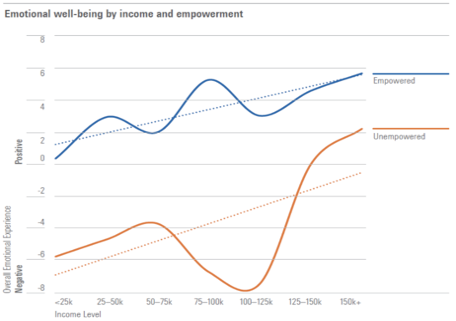
To demonstrate the evidence, the graph below compares people who feel empowered by their finances with people who don’t. It shows empowered people had mostly positive experiences with their finances, even in the lowest income ranges. Those who felt disempowered were less happy than their peers and didn’t reach the positive range until their annual earnings were well above $100,000 (US-based stats).


Source: https://www.morningstar.com/lp/when-more-is-less 

Traditionally, financial planning and advice have centred around “crunching the numbers”. This was because it was perceived as more of a management function and not a relational function. In recent years we have seen a shift from financial planning being a transactional engagement to being more relationship-centric, with products and services taking a back seat along the journey and the advisor riding upfront with their client.

Instead of being on the sidelines, we are partners in prosperity on your road to financial success. The lesson here is fascinating: A sense of financial wellbeing—as well as the money itself—may be the key to success in our financial lives. So, please reach out to me if there are some behavioural traits, such as reinforcing good investing habits, that we can help with. 

Even if you have enough assets to withstand a reasonable economic shock, it doesn’t mean that you won’t be anxious about your finances. On the other end of the spectrum, some of us aren’t in the greatest place economically, and despite best intentions, we still spend with abandon because we feel fine about our finances.

If we want to be truly successful, we must find a balance between the two.

What’s an annuity?

The journey begins here

ABOUT US

Charting your way to financial wellbeing.

ANDRE SINOSICH

DIRECTOR/FINANCIAL PLANNER

A Warmbaths local, Andre finished began his financial training with Old Mutual and went on to work with First National Bank’s Financial Planning division. With a solid industry knowledge, a long history with esteemed financial services providers and a deep local heritage, Andre is also a committed family man who appreciates the need for solid financial protection and appreciation.

CHRISTIEN SINOSICH

CLIENT LIAISON/OFFICE MANAGER

Christien grew up in Botswana and joined FNB at the same time as Andre, where they both worked as Financial Planners. Together they left FNB in 2009 to establish and build their own independent financial planning practice which is now known as Sinofin Adviseurs. Guiding the business with her vision and managing operational tasks in the office, she has a long and trustworthy career in financial planning.

BIANCA PIETERSE

BROKERS ASSISTANT


YVONNE JANSE VAN RENSBURG

BROKERS ASSISTANT

Testimonials

The best place to invest

The journey begins here

ABOUT US

Charting your way to financial wellbeing.

ANDRE SINOSICH

DIRECTOR/FINANCIAL PLANNER

A Warmbaths local, Andre finished began his financial training with Old Mutual and went on to work with First National Bank’s Financial Planning division. With a solid industry knowledge, a long history with esteemed financial services providers and a deep local heritage, Andre is also a committed family man who appreciates the need for solid financial protection and appreciation.

CHRISTIEN SINOSICH

CLIENT LIAISON/OFFICE MANAGER

Christien grew up in Botswana and joined FNB at the same time as Andre, where they both worked as Financial Planners. Together they left FNB in 2009 to establish and build their own independent financial planning practice which is now known as Sinofin Adviseurs. Guiding the business with her vision and managing operational tasks in the office, she has a long and trustworthy career in financial planning.

BIANCA PIETERSE

BROKERS ASSISTANT


BIANCA PIETERSE

BROKERS ASSISTANT


BIANCA PIETERSE

BROKERS ASSISTANT


Testimonials

Levels of financial dependence

At the very surface level of constructing a financial plan, the journey can feel linear. We begin with what we have and plan to move towards an end goal of ‘having enough’ and being financially independent. But this is not where financial planning ends; it’s just the toe-dipping beginning as we gain courage and confidence to engage more with our financial planning.

It feels linear because financial independence has always been closely associated with retirement, and retirement has been seen as our final epoch. There are not simply two stages of financial dependence; there are several, and we don’t necessarily go through them all, neither do we all end up fully financially independent.

Life is a little like snakes and ladders – we can be moving forward (upward) on our chosen path until illness, divorce, or retrenchment changes our financial dependence status. Or we may have a windfall or unexpected success that boosts us up several spaces in our plan.

The importance is not in sticking to the linear journey but in creating check-in points to mitigate stress and measure success according to our personal milestones. 

This gives us the freedom to make choices that might move us up or down a level in our financial dependence – like extending our bond to buy a larger house, or turning down a better job offer to spend more time with our family.

Understanding different levels of financial dependence helps us with the framework of our financial plan.

Dependence is where many of us start. At this level, our lifestyle depends on others for financial support. Support from parents, needing to spend more than we earn, or if our debt payments (credit cards, personal loans, student debt) exceed our income, are all common at this level.

Solvency is the ability to meet our financial commitments. We reach this level when our income exceeds our expenses and when we are no longer accumulating debt. We are fully able to support ourselves with our income.

Stability is a stage of financial dependence where we have no credit card or personal loans, have established an emergency fund, and are growing our asset base.

If we can keep growing our wealth, we will start to have free agency, meaning that we can work and live how and where we want. Typically, we will have eliminated all debt (including property loans), and have enough savings and invested assets to have the confidence to quit our job at a moment’s notice.

After this point, we now have a certain level of financial independence. We have financial security when our investment income can cover basic needs for the rest of our life. It’s not about luxury or comfort; it’s about financial security to have all the basics covered.

Full financial independence is a stage in life where we can fund our chosen standard of living for the rest of our lives. You can afford the basics and some comforts too. This is what many term as “having enough”.

Abundance is a rare stage where we have enough — and then some. We can share our wealth with others or indulge in luxury.

Remember, these are levels of financial dependence and not levels of happiness or peace of mind! They are purely a helpful way to frame where we are on our financial journey but do not make our journey wrong or right, or complete or incomplete.

Charge what you’re worth

“How much should I be charging my clients?”

This is a common question as we work with an increasing number of people setting up their own businesses. In the wake of a radical economic downturn, our creativity and necessity to generate an income spark new business ideas. The entrepreneurial spirit begins to take centre stage in the micro economy, and we have an awesome opportunity to create value for others.

And this is how we answer the question. Because it’s not about the fees, it’s about the value.

In our own industry, we’ve learnt that our fees should be linked to our value proposition. Whether you’re talking about products or professional services, there needs to be some benefit or value to the end-user. This benefit is measured by the difference that the product or service provider will make for the consumer.

It sounds like a simple formula, but it can get fairly complex. We need to consider factors like experience, expertise and the need for the product or service that we’re providing.

There’s an old story of Pablo Picasso, who, at the height of his fame and influence as an artist, was asked by a fan to sketch something for him. This happened when Picasso was out for dinner at a restaurant. 

The fan gave Picasso a napkin to sketch on and said he would pay for the sketch. In fact, he supposedly said to Picasso, “Name your price.” Picasso took a charcoal pencil from his pocket and quickly drew the image of a goat.

He then said to the fan, “That’ll be $100 000.” The fan was astounded, saying, “But that only took you 30 seconds to draw.” Picasso then crumpled up the napkin and stuffed it into his jacket pocket. “You are wrong,” he said. “It took me 40 years.”

Another way of looking at this concept is to remind yourself that it’s not the hour you spend in that meeting with your client; it’s the years of experience you bring to that hour. Or, it’s not the price tag of the widget you’re selling; it’s the hours of frustration it will save your customer – or the hours of joy it will bring them!

When you start a new business, you will have a learning curve where you will need to adjust price, service, experience – all of it, but remember that it all starts with confidence in your value. It starts with being confident to charge what you believe you’re worth. Price influences our perception of value. Experience confirms it.

As a rule of thumb, always start higher. It’s easier to negotiate down than to negotiate up, and, if you need to, you can always walk away if they aren’t willing to pay you what you’re worth.

Six areas of financial planning

Have you ever gone down the #Fintwit rabbit hole? According to fintwit.ai, #Fintwit is a vibrant community of investors on Twitter, who tweet trading ideas, active trades, personal portfolios and well thought out insights about financial securities. Millions of investors around the world are increasingly using Twitter to stay abreast of the financial market and make informed investment decisions.

This financially savvy community is almost as popular as the #BTC (bitcoin) and #crypto communities who are determined to be the next billionaires from investing in cryptocurrencies. They create boundless content on how to best the systems and one could easily spend days scrolling through all of the tweets.

The challenge with these strongly supported content-creating communities is that they have enormous influence and create the perception that investment planning and management is the main (or only) focus of financial planning. The reality is that investing is just one area of about six.

Financial planning is more about managing behaviour than managing money. This is why the first area is cash flow management.

CASH FLOW MANAGEMENT

Some people refer to this as budgeting or a spending tracker. Ultimately, the goal is to have an enlightened conversation about where your money is going every month. Once we know that, we can plan how we can protect your assets and grow your assets.

RISK MANAGEMENT & PLANNING

From a financial perspective, we typically look at the different assets that need protecting; from your personal health to your income, accumulated savings and investments, this is a list that will keep changing throughout your life. Risk planning falls into two categories – your short term and long term risks. 

INVESTMENT PLANNING

Your accumulated savings are great for emergency funds and rainy-day savings, but for long term growth with the benefit of serious compounding interest, we need to plan on how you invest your wealth. This is all about growing your wealth and allowing your money to work for you. This is where the #Fintwit bunch are always abuzz with ideas – but at the end of the day, you need a person who you can trust and lean on to keep you committed to your investment plan.

TAX PLANNING STRATEGIES

As your wealth grows, your tax liabilities will increase. Optimising your portfolio becomes a necessary discussion in order to reduce the amount of money you will have to pay to The Man. There are loads of strategies to legally protect and grow your wealth without eroding it to tax.

RETIREMENT PLANNING

In a nutshell – this is a sum of money that will help you rely less on income generation later in life. It doesn’t mean you have to stop working, or stop adding value – it just means that you are working to create more freedom for yourself so that you don’t have to work every day in order to pay your monthly bills and finance the lifestyle that you’d like to live.

ESTATE PLANNING

All of this asset building, combined with your risk portfolio, creates value in your personal estate. It doesn’t have to be millions; whatever you’ve built will be taxed when you pass away. To plan for this and reduce that tax liability and associated fees, estate planning ensures that your loved ones will have access to most of what you’ve been able to provide for them.

These are the most common areas of financial planning: cash flow management, risk management, investment planning, taxing planning, retirement and estate planning. They create the starting blocks for our conversations to help you manage your behaviour to ultimately manage your money better.

The higher the fee, the better the value?

How do you decide on the better of two products you are not really familiar with or can’t visually tell the difference?

For example – I had to buy a new cellphone charger the other day, and there were two options – one was two-thirds the price of the other, but both were reasonably priced (according to my limited experience of buying chargers!).

I went with the more expensive one because the price tag convinced me that it would be the better choice. If I knew the industry, I would probably know that they were both made in the same factory in some far-off land – but the higher price convinced me of higher value.

You’d probably do the same. It’s the same with buying a car, paying for food at a restaurant, purchasing new shoes and just about everything else that we pay for. Price skews our perception of value.

It’s also the same for investment fees. Sometimes we can assume that the higher the fee, the better the return.

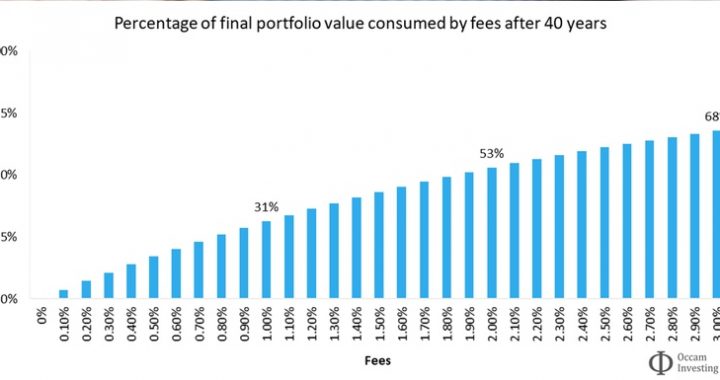
But – as we can see in the graph above, this is not the case for long-term investment strategies. Over time, fees can erode over 60% of our final portfolio value. That’s why, when it comes to hard and fast rules for fees and certainty in investing – they simply don’t exist.

However, we can say that in most cases, lower fees lead to higher returns.

As Occam Investing wrote in a recent blog, “There are no such things as laws in investing.”

When it comes to markets, we can never share the same level of certainty as we do in Newton’s laws of motion.

Trying to prove something in investing is like Newton trying to prove gravity exists in a world where sometimes things are pulled towards each other, sometimes they aren’t, sometimes the opposite happens, and sometimes something invisible comes out of nowhere and throws everything around a bit.

To make matters even more difficult, the environment in which we’re operating is always changing. Newton was able to prove gravity existed because the laws of physics never changed – he was able to run experiments while keeping everything else constant. But markets are always changing.

Investors can never really be sure of anything – we’re left to make the best of unprovable theories and confidence levels while navigating an environment in constant flux. But no matter how much changes in markets, no matter how many theories you choose to place confidence in, one thing will remain true regardless of approach.

All else equal, lower fees will result in better performance.

And although all else isn’t always equal, both the theory and the evidence show that the best and most consistent way to increase returns is to reduce fees.

This is a powerful conclusion for investors. While so much of what happens during our investing lifetime is outside our control, how much we pay for our investments is very much inside our control.

Given that the amount paid in fees is a great predictor of performance in investing, focussing on reducing fees is the most reliable way investors have to increase their odds of investing successfully.

If you’d like to read more of the technical analysis of this conclusion from Occam Investing in the UK, you can click here.