Is active or passive fund management better?

The first thing to remember when approaching investing is that the best approach is dependent almost wholly on the investor and their desired investment outcomes. While this may sound simple, working out desired outcomes hinges on many factors and conversations and ultimately works out best when a trusted financial adviser guides the investor.

In a nutshell (this is a very simple explanation):

  • Active fund or portfolio management is overseen by a team of investment, market and fund specialists who make regular trades to achieve a benchmarked return.
  • Passive, or index fund, management is typically where the portfolio is designed to parallel the returns of a particular market index or benchmark as closely as possible. A passive strategy does not have a management team making investment decisions and can be structured as an exchange-traded fund (ETF), a mutual fund, or a unit investment trust.

So – which is better?

When we chat about your specific needs, we will help you determine investment criteria like how much growth you need for your money and how long you have to grow it. Your perception of risk (risk appetite) and personal feelings around investing also start to come into the conversation as you consider the types of funds, stocks and companies in which you might invest. These will influence the journey we take to helping you decide which option is better suited.

What will most likely happen through this journey is that you will recognise that you have different types of investment needs: business finance, education fees, purchasing property, travel, lifestyle changes (retirement) etc.

As we develop this conversation, the need to diversify and adopt a hybrid investment approach means that we may select passive index funds for certain goals, whilst we make deliberate choices for active fund management for other investment goals.

The markets are also dynamic, as are the strategies for protecting and growing our money. Upheavals in stock markets, politics and social landscapes can change both the approach to investing as well as your financial needs. As your portfolio grows, you will also have more scope (and most likely some more appetite!) to engage in different funds and fund management.

Active funds normally have a slightly higher fee (because they anticipate better returns) whilst passive funds are more cost-effective. Ultimately, the markets and the future are not sure-things, which is why a balanced and well-thought-out approach is always advisable.


Divorce and your retirement savings

Recent times have been life-altering for so many, from emotional and health traumas to relational and financial traumas. We’ve all had to encounter a considerable onslaught of ‘stuff’ to process and deal with.

It may just be life, but it’s still hard.

Divorce is one such trauma that so many have to work through. It has a wide range of social and financial implications, as Lebona Khabo from Allan Gray highlighted in a recent article on their website.

Depending on your matrimonial property regime (considers implications like community of property, accrual, pre-marital ownerships etc.), there may be a sharing of assets you own individually or jointly when you get divorced. One such asset that may be included in this division is your retirement savings, which may have been accumulated over a long time. 

Retirement products fall under several legislations when they represent assets that are jointly owned (subject to tax legislation and family and divorce legislation) – and this creates complex considerations in a divorce settlement. 

Furthermore, some of these products may only mature at a future date, so whilst not available to the principal member, they may have future value to dependants. This needs to be included in a settlement. In many instances, court challenges have made provision for a ‘clean break principle”, which allows for the non-member spouse to receive their share of the benefit, referred to as “pension interest”, at divorce.

Pensions interest encompasses marital regimes and the type of investment, and is a dynamic principle of law that is constantly evolving with applications and legal challenges.

All of this is a very high view of a complex and technical area of financial planning and law, so please remember to check the specifics of your unique situation before making any decisions or signing any agreements.

Ideally, you want to keep things short and simple. A divorce order should: 

  • Ensure that the retirement fund is identified, or identifiable.
  • Provide that the non-member is entitled to “pension interest”. An order that refers to “interest”, “full value” or ”retirement interest”, may be invalid. (this may vary in different geographical jurisdictions)
  • Provide for the pension interest amount or percentage that must be paid to the non-member (e.g. “50% of pension interest”).
  • Instruct the retirement fund to make the pension interest deduction.

If you are going through a divorce, it’s probably one of the hardest things you will ever do. Surround yourself with people you trust to help you make the best decisions for your future. There will be immense pressure to ‘wrap things up’ and ‘end this quickly’ – but this can cause us to make decisions that we will regret later.

Take the time you need and speak to the people you need to before making any decisions that will affect your future financial wellbeing and personal happiness.

Tax Savvy Investing

Nothing is certain in life, except for death and taxes. Benjamin Franklin said this almost 300 years ago, and it still rings of truth.

The economic and political landscapes are now even more complex and connected than they were in the early days of American politics and free-market exploration. Making money has never been easier, whilst at the same time, it’s never been harder to keep.

Saving and investing seem to be things that ‘only the wealthy’ get to do, but the reality is that we can all save and invest in ways that are both accessible and appropriate for personal setup. Every country has its own opportunities to invest… but they also have their own tax laws. With the global community in which we live, many of us have opportunities to work in other countries (whether we emigrate there, or work remotely) and this creates deeper levels of complexity to our financial planning.

Regular tax assessments of our investment policies and products allow us to benefit (if we’re staying informed and on top of them!) from tax relief. Receiving a monthly pay-check is becoming less certain as contract work and freelancing become the new normal for many of us. This means that we may not be paying tax every month and could be caught off guard by tax responsibilities at the end of the tax year. 

There are ways to structure your expenses, and investments, to lower your tax bill. 

Here are some of the most common ways to invest in a tax-savvy way.

Maximise your tax-free investment limit 

Whilst most long-term investment products are designed for retirement, that conversation is fast reaching the end of its shelf-life with investors realising that there are other ways to support a retirement lifestyle (in addition to retirement savings). As such, tax-free investment products offer a little more access to invested money but are usually capped by the Government to limit the abuse of these investment structures. As the limitations are reviewed every year in the treasury budget speeches, and most of us don’t usually contribute to these products often, there could be some headroom in there to stash some cash and keep it tax savvy.

Bolster your RA 

As mentioned above, a retirement annuity (RA) is a staple choice for long-term investing. As you explore other supplementary investment options, don’t forget this one! If your employer doesn’t provide some sort of pension fund benefit, a retirement annuity is a great way to invest for the future. 22seven recently put it like this – 

“The benefit of a RA is that interest, dividends and capital gains earned accumulate within the RA and aren’t taxed until you retire. A comfortable retirement is important to everyone and you don’t want to give all your years of hard work away to the Tax Man.”

Every country and region differs slightly in how they structure these products, so if you’ve recently moved, or changed jobs, it might be helpful to double-check.

Get savvy around capital gains tax (CGT)

In a nutshell, when you sell assets, shares, stocks or any investments and you generate a profit, this is considered an income (your capital has gained) and will be taxed according to its income code. In some cases, you may be liable for a CGT exemption or relief if the profit earned is below a certain threshold. There are further stipulations for assets that are held by a legal entity (not a natural person) – and these differ from one jurisdiction to another. 

What this means is that if you’re wanting to sell off some investments, it might make sense to time them either side of the tax year-end in order to benefit from annual exemptions. You may also want to consider transferring assets to your company, or to your person, in order to leverage other savings. But, don’t make it more complicated if it doesn’t have to be.

Sometimes we can over-optimise and land up paying fees in other areas that could be more costly than the tax we’re saving.

Ultimately, it pays to have a professional helping you navigate these options. You don’t have to make these choices alone, let’s have a chat if you think you could be saving where you’re currently spending!

Stocks vs Shares

In the world of investing there are myriad ways to create wealth. These systems are complex, integrated and offer just enough certainty to attract our attention, but not enough to be a sure-thing.

Two investable options that are talked about daily are stocks and shares. They sound and look very similar, but are in separate categories of investing and offer slightly different opportunities and have disparate risk exposure.

In this blog, things may get confusing, so if you need a conversation about what’s going on, just ask!

Here’s a quick overview:

Whilst both stocks and shares offer opportunities for ownership or profit earning in a company, they represent different denominations of value. Stocks are sold to investors in order to generate capital when a company needs to raise money, and these stocks are broken into shares. We can loosely think of shares as equal fractions of ownership in a company. Stocks can include shares from multiple companies (spreading risk) whereas shares exist inside one company.

Shares are normally issued at the startup of a company and divided amongst the directors, but can be offered in packages to new staff to attract them to the benefit of staying and building the company.

According to educba.com, they set the differences out like this:

  • Stocks are the collection of shares of multiple companies or are a collection of shares of a single company.
  • Shares are the smallest unit by which the ownership of any company or anybody is ascertained.
  • A stock is a collection of something or a collection of shares. Shares are a part of something bigger i.e. the stocks.
  • Shares represent the proportion of ownership in the company while stock is a simple aggregation of shares in a company (or multiple companies).
  • Shares are of equal denomination while stocks are of different denominations. Shares can also never be transferred in the fraction, whereas stocks can be transferred in the fraction.
  • Shares are issued at par, discount or at a premium. It is known as stock when the shares of a member are converted into one fund.

For instance, let’s say Mr. Schmidt has bought certificates of Apple Inc. then in this case we will call these certificates as shares as it can be seen that Mr. Schmidt has bought certificates from a particular company. Now, on the other hand, if Mr. Schmidt has the ownership of certificates from several other companies as well, it can be said that Mr. Schmidt has certificates of stocks and not shares.

Those who own stocks in a public company may be referred to as stockholders, stakeholders, and shareholders, and in reality, all three terms are correct.

As these concepts start to merge and integrate on deeper levels, it gets a little more complicated. Although the term shares generally refer to the units of stock in a public company, it can also refer to other types of investments. For example, you might own shares of a mutual fund. Some companies also offer plans or incentives in which employees get a share of their profits. It’s common among start-up companies to offer profit-sharing plans to attract talent, though some established companies engage in this practice as well.

Both stocks and shares are important in their own terms and they help us when determining the ownership in a company, or companies in their respective cases. They are used interchangeably when talking about company ownership and stock markets.

Source article

Who’s advice are you taking, seriously?

Times of festivities and celebrations are often paradoxical in that we want to see friends and family, but we find that when we’re with the ones we don’t often see (only for big occasions and end-of-year-bashes), they have opinions that challenge our own and they’re all too willing to offer advice that we haven’t asked for.

This is okay – we don’t have to take their advice too seriously, especially when it comes to managing our money. You can choose to stick to the advice of your trusted financial advisor.

When it comes to managing our finances, listening to too many voices can be dangerous. It’s often said that when you’re buying a car, the more people you speak to the more confused you’ll become. The same is true of your finances.

In our relationship, we want to help you avoid common financial planning and investment mistakes. This doesn’t happen once a year at a lunch party where the financial conversations tend to be rather superficial. This happens regularly and only after deeper conversations around meaning and purpose have been explored and brought into context by the money that you have.

This is instrumental in helping you make decisions that are right for your circumstances and, importantly, helping you to avoid the pitfalls of investing on your own. Recently published on Allan Gray’s website, here are some powerful reminders of why those who have financial advisors (and take their advice…) fare financially better.

Investing without a plan

A well-crafted financial plan is a critical starting point for achieving financial freedom. If you don’t know where you’re going, how will you know when you get there? An advisor will help you to develop a workable plan to suit your personal financial goals and needs.

Investing in the wrong product

The choice of products available is mind-boggling. Different products have different tax structures and different objectives. An advisor can help you make the choices that suit your circumstances.

Forgetting inflation

Time can erode the value of your money, leaving you able to buy less with the same amount of rands. This is called inflation. By putting your money in the right investment, an advisor can help you achieve returns that, at least, compensate you for the length of time that you invest so that the value of your money is maintained.

‘Blowing’ your retirement savings when changing jobs

It’s essential to preserve your retirement savings when you change jobs or if you are retrenched. If you don’t, you probably won’t be able to retire with enough money to live on. An advisor will encourage you to keep your savings intact.

Acting on your emotions

Investors are known to be bad at timing the market and basing investment decisions on emotions. In addition, they tend to switch between investments too often, destroying the value of their savings. An advisor could help you avoid this pitfall.

So – who’s advice do you want to take seriously? When someone has skills, experience and qualifications that can help you AND has spent time understanding your needs and helping you put a plan in place that reflects your goals and your risk appetite – you take their advice, seriously.

Investing: How elections matter

There are three things we should never discuss around the dinner table: money, politics and religion. Ironically, the three things we normally always talk about around the dinner table… are money, politics and religion!

One reason for this is because they’re all connected, and they’re all HEAVILY influenced by you, me and everyone that we talk to, work with and interact with on a daily basis. The markets, politics and religion all give us a sense of belonging, purpose and stories to share. These are three of the four fundamentals that give us meaning – so… we’re likely to talk about them at any chance we get.

Depending on the crowd we’re with, our conversations will be dominated either by academics or opinions or perhaps a balance of the two. When it comes to elections (both in our country and others), the situation is the same too – so when you’re next around a dinner table, here are two crazy academic points that you can contribute to the conversation.

MARKETS – LOCAL AND OFFSHORE

The most obvious sentiment when it comes to elections is around confidence in the leadership. This confidence (or lack thereof) will directly influence investor confidence. This can be both local and offshore – if we don’t like what our leaders are doing, we are less likely to invest in local business (markets) and more likely to look at a heavier offshore weighting. The same too would apply to those who are sitting outside our country – and determine whether money is pumping in, or out, of our economy.

Administrative policies play an equally important role here as new administrations often like to shake up policies of previous administrations. These affect everything from the support offered to businesses at every level, living standards of the workforce, education and health for their families and the taxes we will pay for goods, services and investments.

This all leads to a more immediate impact – and that is the strengthening or weakening of the currency. Our buying power goes up and down accordingly – and once-again circles back to how much we can afford to invest in our local economy.

TRADE RELATIONSHIPS

Elections in other countries can also heavily influence what happens in our market as we have significant trade relationships with them. In his book, 21 Lessons for the 21st Century, Yuval Harari reminds us that all our communities are so intrinsically connected through trade-relationships that it’s hard to stand for any cause or initiative without indirectly supporting the opposition.

The clothes we wear, food we eat, cars we drive, technology we use and the social media platforms that we communicate with and stay in touch on are all manufactured, harvested, designed and maintained using intricate global networks. 

A trade relationship that affects the parts that my car company needs to import could mean that my car takes longer to service, and will cost me significantly more than before. The food I used to enjoy from my local grocer could also become less readily available and attract a premium for import duties when it is available.

Elections matter – not only our own but other countries’ too. The next time your dinner party runs wildly away with passionate opinionistas, you can throw in the above nuggets and sound like an investment guru!

The gift of compounding interest

Every holiday season, the search begins for gifts that keep on giving. From music to cooking classes and other hobby-related courses – scores of us try to find a gift that won’t be tossed onto the pile of unwanted, unused and under-appreciated thingy-me-bobs.

We look for things that are ‘cool’ or ‘trendy’ – but ultimately, it’s precisely the same quality that makes a gift trendy that will give it the shelf-life that we’re trying to avoid. 

Most of us don’t think of accounts or investments as gifts – but maybe we should.

Albert Einstein called compound interest the eighth wonder of the world, accrediting it as the most powerful force in the universe. With an accolade like that – surely it would make a worthy gift?

There are two types of gifts – there are those that we give others (most commonly how we view them) and those that we give ourselves (we often feel guilty about these and do this far less often).

Giving ourself gifts is actually extremely cathartic and helps us maintain positive mental health. In a world where stress, constant change and prolific misinformation abound, looking after our mental health has never been more important.

So – whether you’re searching for a gift for yourself, or someone else, how about thinking about the gift of compound interest?

There are three ways to set yourself up for a successful endeavour that reaps the benefits of the gift that keeps on giving:

1 – Create a habit of saving

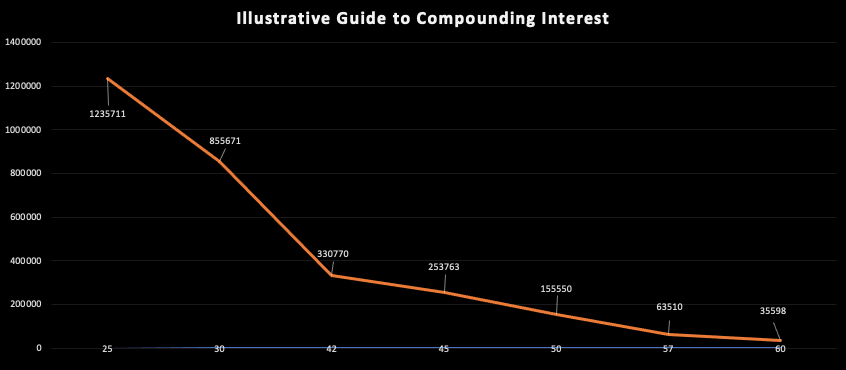
Longterm investing that benefits from compound interest is ultimately more about the consistency and longevity of saving than the actual amounts that you’re putting in. In the graph below (purely for illustrative purposes) we can see that someone who commits to investing 500 bucks a month from when they’re 25, will have significantly more growth on their money than someone who clocks into the habit in their 50s.

Putting a small amount away, habitually, for many years, is where the most powerful force in the universe starts to shine.

2 – Investigate the tax benefits

Many savings vehicles that are set up for long-term investing have tax benefits that will inadvertently increase the value of your investment. This doesn’t apply to all types of investments, but it’s worth investigating. Remember, a penny saved is a penny earned!

3 – Buy yourself time

As Warren Buffet says; time is your friend and impulse is your enemy. This ties in with the first point in that building a habit of saving will also buy you time. The longer you can invest your money, the more work compounding interest will be able to do to your end figure.

The above graph is based on someone investing 500 bucks a month with a 7% return and shows the projected return at 65, after investing from 25, 30, 42, 45, 50, 57 and 60. The later you start, the less you get.

Most of us know these principles, but a regular reminder is helpful to either start a wise investment, or stick to one we’ve already started.

If you’re not already enjoying the gift of compound interest, hopefully this blog will inspire you to take the next steps!

Taking stock and talking stocks

Anyone with a mediocre knowledge of investing will be familiar with the term “stock”. 

But few people are aware that there common stocks and preferred stocks. And they’re fundamentally different.

Stocks have been traded for over 400 years – the first common stocks were made available in 1602 through the Dutch East India Company. They form the building blocks of our modern-day economy and have taken on personalities of their own.

In a nutshell, here’s what we need to be clear about when it comes to working with preferred stocks and common stocks.

Both represent a piece of ownership in a company, and both are tools that we can use to try and profit from the company’s future successes. The differences come down to what privileges or rights we will enjoy and how risky our investments are.

The first key difference is in voting rights. Preferred stock owners do not have any say in how the company is run, whereas common stock owners enjoy voting rights. This is most often one vote per share-owned and allows a say in concerns like the election of board members who oversee management’s major decisions. Common stockholders can influence corporate policy and management decisions where preferred shareholders do not.

While they may have less say in the company direction and management, preferred shareholders have priority over a company’s income and are paid dividends before common shareholders. This offers slightly more investment security and predictability when a company performs poorly, as dividends are generally paid out more regularly and aren’t always paid out to common stockholders. In times of liquidation, the preferred shareholders have first dibs on assets and earnings.

Common stockholders are last in line when it comes to company assets, which means they will be paid out after creditors, bondholders, and preferred shareholders. In this way, preferred stocks are very similar to bonds. 

The payoff for common stockholders (the most popular form of stock allocation) is that the gains can be significantly higher in the long term if the company grows and finds a solid footing in the market as a profitable entity. They may not reap the rewards of dividends in the early days, but they stand to reap more in the long term.

Depending on your personal investment strategy and event horizons, it may be worth considering preferred stocks over common stocks or vice versa. It’s good to remember that preferred stocks can be converted into common stocks, but we can’t go in the other direction.

Three ways to survive a bear market

What do you do when a bear attacks?

For many of us, we don’t live near any bears, so we’re likely to be unprepared. When it comes to a bear market, the situation is not too different. No one can predict a bear market, and for some it’s not even easy to recognise when a bear market begins and when it ends.

The general agreement is that bear markets are characterized by a consistent drop in the market, accompanied by negative investor sentiment. The more we work with markets and investing, the more frequently we are reminded that emotions are instrumental in driving the markets. Negative sentiment is, therefore, quite an important element of being in a bear market.

As we look at ways to bolster our investments in bear market conditions, here are a few strategies to employ (taken from Investopedia.com), but before you try any of them, make sure we’ve had a chat to understand your unique situation. If a bear rummages through a campsite, it’s possible for your tent to remain unscathed. Not everyone struggles in a bear market!

Keep calm… and move slowly

Just like the wilderness encounter, experts advise you to remain calm and make no sudden movements in the presence of a bear. The same is true of the stock markets. Sudden movements and panic decisions can cost you an arm or a leg…

Diversify

Diversification is almost like looking for a more solid footing and spreading out a little. This not only gives you more stability but it ‘keeps your head down’ and allows you to physically take up a little more space without placing yourself in a more precarious position. Being caught off guard can also mean that we’re caught off-balance. Diversification of stock allocations helps us ensure balance and encourages stability in our portfolio.

Only invest what you can afford to lose

Bear markets are often accompanied by other market downturns, with people in all sectors needing to tighten their belts and sharpen their pencils. There is less expendable income, making it even more important to focus on covering our bases first before extending our risk. It’s wise to have savings and investments, but we also need to put food on the table and take care of our everyday needs. Even small adjustments in the market (in the wrong direction) can be detrimental to your portfolio, and it will need time to recover. 

The markets always present opportunities, even in a bear market, but it takes a comprehensive strategy and a team of astute investors to survive. Don’t go it alone, and don’t dabble without weighing up the risks.

What lockdown taught us about wills

When lockdown happened, it happened fast. For some, there were only a few days to prepare for an indeterminate time of severe restrictions. For others, they had more to do and less time in which to do it.

Travellers were stuck abroad in foreign countries and had to follow equally foreign regulations. At times like these, risk cover and emergency funding are a crucial crutch when our finances and our freedoms are crippled.

Granted, few people have such extensive financial resources, and many experienced an even more challenging time after the economy was halted. There are legal documents that can give us extended peace-of-mind so that we have less to worry about. A will, last testament, and estate plan are documents that we can use to bolster our financial plan’s reach and health.

Here’s the thing about financial planning: we don’t plan out of fear; we plan so that we can extend our peace-of-mind. This is why wills form such a key role in our planning.

Global panic in early-to-mid 2020 led people worldwide to think about these documents, and requests for them to be drawn up or updated were aplenty. The risk of creating these documents under duress is that we can make mistakes, sometimes in what they cover and other times in their legitimacy when official procedures are overlooked (or not available as in hard lockdown).

We seldom have warning for life-changing events, and while it’s easy to say that ‘we should have planned’, we can be proactive after the event and choose to thoroughly investigate our plan right now – in our time of recovery and rebuilding.

Many of our notable companies who make these documents more readily available and ensure that they’re correctly adhered to in their compilation and execution made a plan during hard lockdown to ensure that their clients were adequately protected. This reminded us that it wasn’t impossible; it was just more challenging. 

As the pressure lifts (for however long), we have the opportunity to reassess our wills (and any other elements of our financial portfolios) and estate plans. We no longer live in the age of a handshake or a gentleman’s agreement. We live in a world striving for equality and freedoms that have the trade-off of potentially leaving us more exposed and vulnerable if we don’t have our responsibilities attended to.

As Mvuzo Notyesi, president of the Law Society of South Africa, says, “If you are a parent, a breadwinner, a homeowner and generally want to ensure that your affairs are in order, it is important that you have a valid will drafted by an attorney.”