Watching what you spend… and what you eat!

With all the treats at the social gatherings, watching both your budget and your diet during the festive season can be a challenge.

Whether we’re talking about savings goals, or weight goals, it’s easy to get a little carried away. It’s wonderful to treat your loved ones and enjoy yourself, and during a holiday it’s important to be kind to yourself and let loose a little. However, if you want to enjoy the season to its fullest, it’s helpful to have a positive mindfulness towards what you’re consuming.

An over-inflated tummy can be just as troubling as over-inflated expenses that need to be paid back in the months to come.

With the former… here are some tips you can use to help you keep to your health goals during the festive season!

Eat lots of fruit and vegetables

Whilst you don’t have to stick to every calorie (because that’s a serious buzzkill) use your current dietary goals as guidelines that you’re willing to be flexible with.

Fill out every meal and snack time with fruits and veggies. You can even bring your healthy meals to the social events you will be attending. Offering to bring your own dish of greens may be a good idea.

If you’re hosting, that means you have control of the menu. You can make healthier choices when shopping for the party, your guests may appreciate some healthy (and tastier) alternatives too. Healthy eaters are happy Peters!

Eat enough – check your meal portions

If that lavish roast on the table, with all that sauce, looks too good to avoid, don’t go wild on it. Have a glass of water before a big meal and you will be less likely to overeat. Don’t continue eating even when you feel full, you’ll regret it an hour later and enjoy the rest of your afternoon/evening far less.

If you have kids, or are celebrating with other people who have children, check how they feel about sweets and treats and don’t hand out chocolatey temptations without their consent.

If you go to restaurants with harvest tables, remember that the size of your portions equal the amount you will pay. So, being practical about your meal portions means being practical about your finances as well.

As the host, don’t over cater; avoid wasting food and don’t go over your food budget.

Keep to your exercise regime by changing it up a little…

Another key aspect to feeling happy and healthy is stimulating the flow of endorphins. It’s not always easy to keep up with a training schedule, or gym visits over the festive season, so why not consider mixing it up a little?

If you can’t run on the treadmill, ask your family to join you on a walk or trail. Spend some time on the trampoline with the kids, swim some lengths in the pool with a child on your back or play some pool games with your mates. Take the dogs for a run on the beach or explore a new trail that you’ve been dying to visit.

Remember, looking after your health doesn’t have to happen under the false-lighting of a near-empty Virgin Active.

Making mindful choices during the festive season is good for both your health and financial goals. Your holiday budget should align with your health goals, how much (and what) you eat will affect how much you spend.

You are in charge. You’re able to make healthy choices that will help you enjoy the festive season. Eat well and spend well!


When to re-think your medical plan

The first benefit of medical cover is peace-of-mind, the second is that you will be protected from potential financial ruin should your hospital bill be more than you can manage. It is important to be on a medical plan that suits both your monthly affordability and caters to most of your medical requirements.

Since changing your medical plan or option can be costly, you need to change at the right time and for the right reasons. Here are some tips on what to consider when you rethink the suitability of your medical plans.

Change at the right time

It is advisable to change medical plans or options at the end of the year, so you get to access the full membership benefits for the new year. Changing at the end of the year also does not carry the penalty costs you would have had to pay when changing mid-year, but having said this, many medical plans do not allow for upgrades in the middle of the year.

Check benefit limits

It is important for you to know what your plan covers, especially if you or your dependents have chronic conditions or special medical requirements, but also to know where the limits will kick in. For example, would you be needing new glasses every year? Some medical plans allow for a new pair every year for every member, whilst some will only allow for one per year for the whole family and others will take the cost out of your medical savings.

For more serious conditions, it’s helpful to know if you can claim multiple times in the year and where your limits will start to attract co-payments or no longer be covered by your medical plan.

When changing to a new scheme, make sure that the benefits of the new scheme are a good match for the health conditions you and your family experience or are likely to experience.

Upgrading or downgrading options needs to make sense

Moving to a higher or lower cost option within the same scheme also needs to make sense. It’s wiser to only change to a lower option because you have less risk and the benefits you need are still covered in that lower option, not because you want to save money.

Look for your favourites

As you rethink your medical plan, find out whether visits to your favourite GP will be paid for by you or the new scheme. Check if the GPs and specialists in your area are covered, in case your medical cover only pays for visits to someone across town or far from you.

If you’re feeling overwhelmed with how to make a change (or if a change is even needed), then let’s have a chat and see how we can work together to help you make a better decision.

Sharing Is Caring

You’ve learnt lessons throughout your life. Some of them are unique to you, but many will apply to others too. Being open to sharing these will benefit those nearest and dearest to you – and help you reflect on what you’ve learnt.

This is profoundly true when it comes to how we make decisions around our finances. Sharing these lessons may be a sensitive topic but it’s worth breaking the ice!

Encouraging these conversations promotes honesty and transparency. Everyone has an opportunity to understand the goals and challenges of financial planning, can engage with how it relates to your (or their) personal circumstances and will be able to contribute their thoughts, fears and excitement for what you are building together.

How you share is also important, it is not as simple as saying, “I’m saving money.”

Start with what money means to you, and how it fits inside of more comprehensive events, dreams and goals. If you’re sharing this with your family, take the time to show them how the plans consider everyone. Tell your kids how investing is your way of taking their future seriously for anything they may want to do in the future. Remember, it’s not only about what you’re saving for, it’s also important to discuss what you’re currently spending.

It’s easier to make changes when you need them

As you open up these conversations, it’s considerably easier to adjust your budget and financial plan when needed. Those closest to you are less confused when change needs to happen and so the transition of spending habits becomes smoother; everyone knows why you’re saving – especially if you’ve made it known that it’s a collective effort.

Support is more forthcoming

When you share openly you have far more chance of receiving support to ensure the success of your plans, especially when the people included in the plan are invested in its success! Even if you’re sharing your plans with your adult children, or close friends who won’t benefit from your financial decisions directly, they will be able to support you in achieving your goals.

It’s a little like pushing a car. Pushing a car that has people inside, all by yourself, is much harder than them hopping out and helping you push.

Goals become reachable

When you’re able to be flexible, have loads of support… reaching the goals you’re working towards becomes that much easier.

Telling your spouse or partner that you’d like to save money to renovate your home will help them understand why you want to amend your household budget and with their support, it will be quicker and easier to save for those renovations. They can also help with managing the kids’ expectations and talk about how the changes will benefit everyone in the family.

Sharing your life and financial lessons with those closest to you promotes an environment of teamwork and inclusivity – and teamwork always trumps individual work!

The retirement gap needs a new rap

Retirement (as well as education and the job market) is one of our greatest future-unknowns.

We know it will happen… but we are finding it harder to understand and predict what it might look like. This doesn’t mean we should abandon planning for it. If anything, it simply means that we need to change the way we start to talk about, engage with and plan for retirement.

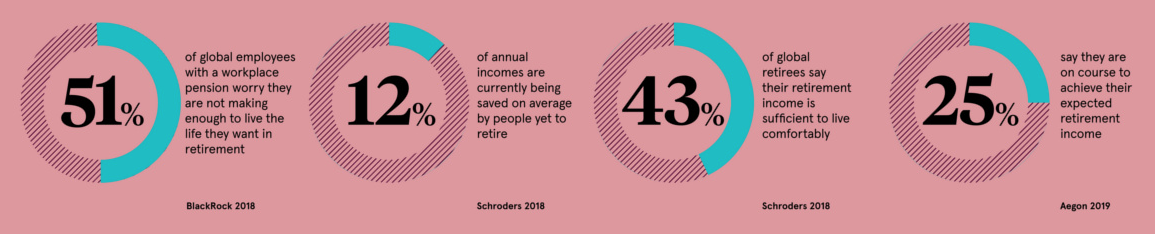
According to a global survey done by BlackRock, about 51% of the world’s working population, worry that their workplace pension will not cover the retirement life they want. This is why most people have a dim view of retirement. But this view is mostly framed by the conversation that retirement is meant to be a welcome reward following a successful working career. In other words, we work for about 45 years, and then we take a 20 year paid vacation….

The biggest problem with this picture is that very few people are able to save for that full 45 year period, and even fewer manage to avoid having to draw on these savings for unforeseen expenses ahead of their retirement.

That’s why we have a rap about the gap that’s not very helpful.

If we are to change this conversation and try to gain a more helpful understanding of retirement, we need to find out how to ask better questions.

How are you shaping your expectations for retirement?

A Schroders 2018 survey, showed that people usually receive less than what they expected their retirement income to be. It is important to know how much you will receive as this needs to align with your planning and your expectations. Whilst retirement is not only about how much you will earn, it’s important to know what you will have to work with.

If you would like to have the opportunity to study further, open a new business, pursue new hobbies, travel or live abroad, planning for a renewable income as well as new income sources is important.

The same Schroders survey also found that 43% of global retirees, who said their income was less than expected, still felt like their retirement income was sufficient to live off comfortably.

Some people continue working into their retirement years; not because they have to, but because they choose to. This is great as it’s part of reframing our expectations for retirement. Ideally, you don’t want to work because you are forced into it for financial reasons, but you also don’t want to avoid work opportunities purely because your expectations of retirement exclude those opportunities.

(Taken from Visual Capitalist.)

What does ‘planning ahead’ actually mean to you?

An Aegon 2019 survey says, 25% of global employees say they are on course to achieving their expected retirement income. This is often perceived as meaning: they’ve started early.

But what does ‘early’ mean for you and your personal plan? Planning for retirement even while in your 20s or 30s gives you more time to invest and grow your retirement capital. But that doesn’t mean you can’t start in your 40s. Yes, the later you start certainly poses more challenges, but not if you have other elements in your plan, or it’s part of how you perceive your retirement.

Defining your event horizon (ie. when you would like to retire) is crucial to both your mindset and your investment success. If you start with a positive and personally relevant view of what your retirement (not someone else’s) will look like, you are far more likely to achieve your goals.

How much are you willing to share with your adviser?

Help from a financial adviser has been proven to significantly improve the financial wellbeing of people – both before and after retirement. However, the level at which financial guidance and intervention can help depends on how much you’re willing to share with your financial adviser.

Building a relationship of deep trust, over time, is most often the best way to ensure open and clear communication in a financial planning relationship. Retirement should be enjoyed, not feared!

Effective planning for retirement helps you create expectations that enable you to look forward to retirement.

Covering cancer in your senior years

One of the less-pleasant facts to face about life in your 60s, 70s and 80s is the fact that you’re more likely to have health issues. The biggest and most expensive, if you read the claims statistics by insurers out there, is definitely cancer. However, there is good news to be had here, even for those in their advanced years.

The good news

Fortunately, medicine and research has advanced dramatically and the ‘big C’ has been taken down a few pegs. Cancer is no longer the death sentence it once was and South Africa in particular has a great reputation for its oncology research and practises, with cancer fighters travelling from all over the world to receive treatment here.

Our insurance is top-tier too – critical illness cover, which includes dread disease cover and is the most common form of insurance to protect against cancer costs, was invented in SA.

Benefits of ‘cancer cover’

Unlike a normal medical aid, which simply covers certain medical procedures for certain covered illnesses (which usually don’t include cancer), critical illness cover is a more whole-of-life solution. This means that it covers not just predictable costs like chemotherapy or prescribed medication, but also any loss of income you may have (if still working) while undergoing cancer treatment.

Certain cancer cover will also pay for therapy sessions for you and your loved ones following the trauma of battling cancer and provide money towards comfort treatments (like wigs for those with hair loss, for example).

All of these make for compelling reasons to purchase critical illness or dread disease insurance. Here’s how, and here’s what to know:

Start as early as possible

First, the not-so-great news: insurance against cancer can be expensive if you’re taking it out after your 50s. This is because the algorithms insurers use to give you your monthly premium amount is calculated based on risk, and typically your risk is higher the older you are. However – it’s a lot less expensive than actually contracting cancer!

“I had cover when I was diagnosed with lung cancer, and we quickly burned through R3 million during treatment in just a couple of years,” said cancer survivor Dr Grant Hatch at Liberty’s recent Lib X launch.

This means that the younger you are when taking out cover, the lower your monthly payments are likely to be – so it pays to start earlier. Another tip: if you have an existing policy with a long-term insurer, for example a loss of income protection insurance product, it’s often more cost-effective to take out a second product with the same insurer than to go to a new one altogether.

Full disclosure is a must

In general, the more you tell about your lifestyle and potential risks, the better for both your insurance premium and the type of cover you can enjoy. Make your age clear to the financial adviser or insurer right away, to avoid any non-disclosure that could mean trouble later on.

But go one step further as well – give as much evidence as you can of a healthy lifestyle. Different insurers have different policies when it comes to health tests they require you to do, but doing the maximum amount and then some is always a good idea. Also be clear to mention if you have a history of cancer in you or your family and be clear that cancer cover is what you want.

Understand what will happen if you do contract cancer

Again, different insurers vary in their approach, but it’s likely that, especially at the age of 60 or older, your critical illness benefit will pay out in lump sum form, which means all of it at once rather than smaller monthly portions. Don’t worry, this lump sum is not taxed – but it does mean that it’s up to you to budget and understand the costs of your cancer treatment and medication in most instances.

This can actually often be an empowering experience, giving those dealing with the stresses of fighting cancer some much-needed hope and purpose. With a good head on your shoulders, a healthy lifestyle and a sound idea of how critical illness cover works, there’s no reason not to be fully prepared, and covered, well into your senior years.

Investing in your health

It’s a well-known and accepted fact that the best time to plant a tree was twenty-years ago! It’s easy to look back and wish we’d started or learnt something years previously, being able to see how it could have benefited us in the long run. It follows, then, that if we didn’t start something years ago, and we wish we had… the second-best time to start is now. This is how we start to create and regain some control over our future.

Planning for our future is a proactive step we need to take… FOR our future.

When it comes to our health, it’s no different. Every decision we make today needs to affect our health positively down the road. Adopting healthier lifestyle habits now, for a healthier and longer life in the future, is an easy-ish first step.

See it as investing in your health for a healthier future. Here are some of the ways we can invest in our health for the future.

1. Keep your mind healthy with positive challenges and new skills

A healthy mind keeps our body healthy. Reading new books and researching different topics is a good mental exercise and in the process we attain new insights, challenging how and what we think.

We can also keep our minds healthier by adopting a positive, solution-based outlook on life. Instead of stressing about our problems, we can shift our focus to creating new solutions and building a robust foundation for tackling life’s challenges.

Lifestyle goals are important in terms of what our mind processes. Visualize a future that brings positive thoughts for our mind. Challenge yourself, learn a new language, learn new skills and develop yourself emotionally, relationally and spiritually.

2. Keep your body healthy by eating and exercising properly

Investing our money on high quality nutritional foods as well as investing our time in regular exercise is important to maintaining a healthy lifestyle and having a healthier body for the years ahead.

When it comes to eating, it’s often more about improving our mindfulness and preparing our meals ahead of time. Bad eating habits are often formed because we don’t pay enough attention to what we’re eating or leave meal preparation to the last-minute and make choices based on ease rather than on nutritional benefit.

Improving our exercise routine works best when we set smaller, achievable goals. If you push yourself too much in the first week, you will crash into a painful heap and discard your fresh goals for comfortable, pain-free habits.

3. Keep your soul healthy by respecting and loving yourself

A healthy soul is important to maintaining a healthy lifestyle.

This begins by respecting and loving ourselves. Setting powerful and engaging goals for our future is a motivating way to start practicing self-respect and self-love, not limiting our possibilities and acknowledging our potential is exciting and enriching!

Your own opinion of yourself needs to be positive; for your confidence, for your soul, for your health!

Investing in our health has to be approached by considering our whole self: body, mind and soul. It’s an important challenge that we need to give ourselves in order to reap the benefits in 10, 20 or 40 years time!

Earning more isn’t the answer

When it comes to building your wealth, it’s not about how much you make, it’s about how you work with what you have. You do not need a larger paycheck, you only need to invest and use your money wisely. Yes, more money gives you a larger budget to work from but that simply needs increased consideration.

Here are some tips that will make it easier to build your wealth, even if you do not have a large income.

Adopt better spending habits

Using your money wisely begins with controlling how you spend. If you earn more, and you land up spending more (often on things you may not need), your wealth building plans will never come to fruition. It will simply be: more money in, more money out.

Good spending habits have a positive impact on your wealth building ability. Practically, this looks like a constant assessment, and re-assessment, of your lifestyle choices in order to spend less on current expenses to save more for future expenses. Essentially, if you spend less now, you will have more to spend later! Remember, it’s not about saving for something random; wanting to spend more later is only beneficial if you have a good handle now and what you might like to spend your money on later (like a holiday, car, wedding etc).

Track your spending

To help you adopt better spending habits, actively track your spending. This can seem scary at first, but ultimately this will help you make empowered choices about how and why you spend your money the way that you do.

Automate your savings

Automating your savings is a powerful way to build a large savings pocket without it feeling like a trying chore. When you manually pay into a savings account, you are more tempted to postpone or miss a month. When this happens, it’s easier to miss next month too… and so a pattern develops. However, if it comes off automatically, much like paying tax, you’re more likely to stick to your savings goals.

Seek professional advice

Key to building your wealth is getting professional financial advice. No matter your income level, you can still benefit from consulting with a professional.

Professional financial advice is about more than helping you set up an investment portfolio or sell financial protection products. As part of your financial plan, this advice should assist you with tax planning, goal setting, establishing meaning for your money AND… help you work with what you have instead of ‘always wanting more’ to achieve your goals.

Building your wealth depends less on how much you earn and more on how wisely you use your earnings. This means that when the time comes, or opportunity affords you a higher income, it won’t be wasted but will instead help you build into your own life and the lives of those around you – providing deeper meaning and purpose for your wealth!

Four often overlooked steps to reducing financial stress

A lot of people are quite financially stressed right now. It’s understandable – it’s been a hard few years for most of us, and the uphill climb back to a bustling economy, both locally and globally, is far from over yet.

Does that mean that we have to be stressed with where SA has been in the past five years? Not necessarily.

You can reduce financial stress with the following tips.

Step 1: Communicate

One of the biggest stressors that comes from money is the negative impact it can have on our relationships. Some of us have been shown by generations before us to suffer in silence and not share the money worries with those close to us.

The effects of that have a deep impact.

Here’s the thing – our partner, kids, parents, friends will always know. We are usually not even aware of the tense face we pull when our child picks the most expensive toy in the shop, or the frosty reception we give when our partner speaks about anything with an expense. The problem is that it’s not easy for them to be sure of whether it’s them or money that we’re frustrated with.

Having an honest, vulnerable conversation with loved ones about finances can be healthy for both family bonds and your bank balance. You might be surprised at how willing your other half supports forgoing certain expenses in order to keep your budget robust. Remember, if you’re anxious about your finances, the people around you probably are too.

Step 2: Get advice

When money is already tight, it may seem unthinkable to get a financial adviser involved. It is important to realize that it means you could end up spending a little more to get access to wealth creation strategies, ideas and investment opportunities that you were completely unaware of and could significantly improve your emotional, mental and financial position.

Going to a financial adviser has the same effect on your spending as keeping a food journal for your diet. With an adviser, you can increase your mindfulness to eliminate waste and focus your expenditure into what really matters to you.

Step 3: Be honest

We need to be upfront and honest in financial planning meetings and conversations. Speak up when it’s hard and you don’t feel ready to make changes. It’s important to talk about what we can no longer afford and what we’d like to achieve. Any change that happens before we are ready for it is often not sustainable.

It is these kinds of conversations that bring value to our financial journey and makes financial advice come alive. We can respond with enthusiasm, find new ideas and forger stronger relationships.

Step 4: Use this time to fine-tune and keep honing

Instead of seeing a financially stressful time as a never-ending pit, rather see it as an opportunity for new growth. Economic downturns, bearish economies, recession and all forms of headwinds always come to an end.

What they provide is the opportunity to get our mindset and wealth creation strategy into a lean, mean machine that will skyrocket when conditions improve!

Five reasons to be stoked on SA

Most of us know someone who has emigrated, or is about to emigrate. After several hard years for our nation, it can sometimes seem like the bad is overwhelming. And, the South African media often seem to talk about nothing except the next new ‘sure disaster’.

But it’s not all bad. There are some great things about being in South Africa right now! We’re not talking about the weather. Wherever you are, looking on the sunny side helps, whether you’re waiting for your green card or maybe sitting around the braai talking about the latest Moody’s rating.

Here, courtesy of Business Insider’s Helena Wasserman, are five reasons to be stoked you’re a ‘Saffer’:

1. Visitors are liking the vibe

South Africa relies heavily on tourism – which is why Statistics SA’s latest news was so great. After the bumper Easter travel season, Stats SA revealed the latest tourism figures ending after April. According to them, over 217 000 overseas tourists arrived in April this year – that’s a whopping 11.9% more than in April 2018. In terms of who our favourite visitors are, Europe still reigns supreme, with 25% more UK tourists and over 30% more Germans. Nations of good taste!

2. Exports are also excellent

If we’re dependent on people coming in, we’re almost as dependent on selling produce outside. According to Wasserman, who quotes the most recent Sars figures: “Exports jumped more than 8% to R112 billion” and “South Africa recorded a R1.74 billion trade surplus in May. This means we exported more than we imported.” This is huge, for a country with a bias towards foreign goods.

3. No rate cuts means easier spending

Two snippets of good news here: firstly, the South African Reserve Bank’s Monetary Policy Committee issued a substantial rate cut of 25 basis points last month. An interest rate cut effectively means it’s easier for us to spend and borrow from institutions – our rands aren’t more expensive than they were before but rather less. This makes it slightly easier for us to spend and support our local businesses, which indeed is what a rate cut is designed to encourage.

Then, on 18 August, at their next meeting, the tide seemed neap enough for interest rates to remain unchanged for the rest of the year. This means that not only is it effectively cheaper to buy and borrow than before but it is unlikely to increase all year.

4. Best of all? The economy is perking up

Yes, you read that right. A number of industries seem to be having a much happier and more productive season than many lately, with the numbers to match. According to Wasserman, “Manufacturing output increased by 4.6% in April 2019 compared with April 2018, with vehicle sector manufacturing up almost 19%. Wholesale trade sales rose by 5.5% in April 2019 (compared with April 2018) while retail trade sales rose 2.4%. Retail sales of clothing and footwear jumped more than 6%, and of household furniture, appliances and equipment by almost 5%.”

5. About those Moody’s ratings…

This will give you something to say to those naysayers around the braai. According to Wasserman, more and more fund managers are of the opinion that Moody’s won’t ‘junk’ SA after all. Last month, only a quarter of the international fund managers surveyed by Bank of America Merrill Lynch believed that we would not be kicked out of the index. This has now increased to 50% – this means that half of fund managers now expect us to keep our investment grade rating from Moody’s. On top of that, the survey also shows that for the first time in six months, managers see our bonds as ‘undervalued’,” she says.

So, perhaps South Africa is actually alive with possibility, after all? It just goes to show, sometimes it pays (financially) to look on the bright side.

Diversifying happiness

The ancient philosopher Aristotle came up with a single word for what every person wants: ‘Eudaimonia’.
Eudaimonia means happiness but more than that it alludes to a sense of fulfillment.

Many people have viewed financial planning as the management of financial goals and resources. Typical conversations would include questions like: “How much will my assets grow, how can I get X amount by the time I am this age and what will my retirement look like?”

Whilst these have been helpful questions, we are learning that they are only part of a fuller conversation. There are different questions that are starting to emerge in our conversations that are focussing more on meaning and purpose. They are not as easy to answer (sometimes they don’t need answers just yet…) but they help us frame the bigger picture of how we’d like to use our wealth for a fulfilling life.

It’s not only our wealth strategies that need to be diversified for healthy growth but our happiness strategy too.

This Spring, we suggest these happiness diversification exercises.

Exercise your way to happiness

Now that it’s getting warmer outside, it’s time to get our bodies moving again. According to a recent research study, exercise makes people happier than money does. People who stay active are better equipped to deal with stress and have less days when they feel down or depressed.

That’s not too say that too much exercise isn’t a bad thing – it’s important to have a balance and not over-exercise. Either extreme can be detrimental to our experience of happiness, but a healthy balance is a powerful way to experience eudaimonia.

Prioritise experiences and people over possessions

Invest in making priceless memories in life. Instead of buying that luxury car you do not need, try saving up for a family holiday. Going out with friends or family to concerts, movies or picnics are just some of the happy experiences you can give yourself in life. Prioritise taking walks in nature, reading a book or playing a game with your kids.

Believe in something bigger than yourself

As we spend time with other people outside of a working relationship, it becomes easier to see and believe in something bigger than our own reality. It’s not about faith or religion, it’s about connectedness. If we want to find more ways to invest in our fulfilment we need to experience generosity to causes that are bigger than ourselves.

Fulfilment, happiness and productivity should grow when we contribute to others. It’s a healthy circle of sustainable growth that is not reliant on market performance or bank balances. Being willing to ask bigger questions and find deeper meaning to our wealth is where we can begin to experience eudaimonia.