A level head saves skewed vision

As Nelson Mandela said, once we’ve climbed a great hill we only find that there are many more hills to climb. When you’re looking up or down the hill, it’s easy to have a skewed vision of what’s really going on. We spend more time going up and down than resting at the top; it’s difficult to hold a level head in times of turmoil.

You may look at your bank statement this morning and see that there won’t be enough to cover your debit orders and upcoming expenses. This is scary! Conversely, you may see plenty of money and fear wasting it!

Money will always flow in and out; the longer we live and earn, the more we are reminded of this.

Whether your financial resources are lean or lush, you may be tempted to make some big moves to manage the coming months as wisely as you can.

When it comes to managing your investments it’s crucial to stay focused on the bigger picture – even when recent events may have you itching to move your investments out of the market and into cash. We need to keep a level head and not skew our vision.

The herd mentality, or groupthink, to ‘cash in’ arises from the fact that cash investments are readily available for use and are mostly free of investment risk. The low risk of a bank failing is essentially the only concern as they are investments on short-term, variable-rate deposits with reputable banks.

However, in an article published at the start of April 2017 in Personal Finance, Leigh Kohler, the head of research at Glacier by Sanlam (South Africa), explained that it’s important in uncertain times to remember that even though a cash investments may seem like a comparably safe option, the returns don’t often beat inflation. According to her, only once between 2001 and 2016, did cash investments outperform local equities and bonds.

Furthermore, if you had been invested only in South African equities over this period, you would have received an average return of 17.12%, compared to just 7.96% if you had only invested in local cash investments.

You are also taking two market-timing risks if you wish to move your investments into cash then back again once things have calmed down, and research shows that getting the timing wrong can be a devastating blow to your portfolio.

What should you do in lieu of making an emotional decision?

  • Slow down your decision making process and include your trusted adviser;
  • Invest in a combination of asset classes in line with your needs, time horizon, and risk tolerance;
  • Invest in a suitable multi-asset fund;
  • Ensure you have sufficient exposure to offshore assets;
  • Understand and believe in your long-term investment strategy, then stick to it.

Scary times come and go – the burden of responsibility weighs on us regardless. How we protect and use our hard earned wealth and accumulated assets need to reflect what’s truly important to us, and not be a reaction to current trends and happenings.

Avoid these investment decisions

Do you know what’s going to happen in the markets tomorrow?

Neither do we!

All we know is that the markets are an opportunity to invest our money in helping the economy grow, and watching our money grow with it. That’s a really simplistic view, but it helps us extract our emotional reactions from the final decisions that we make.

Should we ignore fear? Absolutely not – we should talk about it lots! That’s one of the benefits of having a financial adviser that you trust on your side. Talking things through is a great way to avoid knee-jerk reactions.

Having recently researched some articles on Investopedia and USnews – here are some emotional reactions to avoid.

1. Avoid isolating your decisions
Rather examine the potential impact that each decision could have on an entire portfolio. This applies to selling AND buying. Failure to do this can result in you investing too much in a single asset class, industry, or geographic market. It could also result in your selling off when the market is at its lowest. Remember to step back, look at the bigger picture and then make your decision.

2. Avoid looking at the immediate conditions
Don’t just ignore the potential of long-term wealth accumulation in favour of short-term losses or returns. Statistically, losses happen more frequently over a short timeframe and, as people tend to be very sensitive to losses, a behavioural phenomenon known as ‘myopic loss aversion’ occurs, which affects willingness to take short-term risks. This, in turn, results in people making emotion-based investment decisions that can have a negative effect on a portfolio.

3. Avoid blindly following the crowd
A good investment strategy is to buy low and sell high, but if you follow the masses blindly, it’s easy to end up buying high and selling low, which may have opposite results and prevent you from taking advantage of the same market opportunities. A buy-and-hold strategy is often far superior.

If you know that you can be prone to having knee-jerk reactions, you may wish to try to avoid constant information about how the market or your portfolio is performing, so that you can just focus on sticking to your long-term investment strategy. Don’t chase the news or get swept away by fear and groupthink.

4. Avoid frequent trading
Again, if you are prone to having a sometimes irrational bias towards action you need to slow things down. Moving too quickly can result in higher investment costs and an increase in making poor decisions.

If you ever have itchy feet, it can often be a good idea to wait a few days before executing a big financial decision and seek advice by organising a meeting to discuss an option.

5. Avoid investing money that you cannot afford to lose
It’s important to keep cash on the side for emergencies and opportunities. You may not feel happy having some of your money just sitting there, not earning boastful returns, but having all your money tied up in the market is a risk that’s arguably not worth taking.

To help you make healthy financial decisions, set yourself some rules, such as only contributing a percentage of your monthly income; and establish some realistic targets, such as aiming to save a certain amount of money by the end of the year. Some people can even find it helpful to limit their options by purchasing more illiquid investments to avoid the urge to simply sell or switch on a whim or when the markets aren’t performing as desired.

Many people also find delegation a handy tool. By delegating your financial decisions to a professional who you trust to manage your portfolio, you can spare yourself a lot of stress and rest assured that you will receive sound advice as to how best to execute your financial plan to achieve your goals.

Bear Markets vs Bull Markets

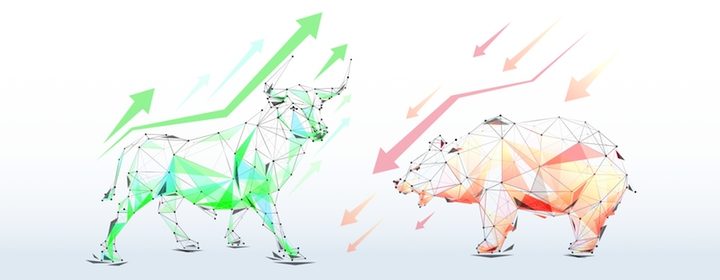
When it comes to investing in the markets, the terms bull and bear market are used to describe how stock markets are doing in general.

Simply put, are they going up or are they going down?

At the same time, because the market is determined by investors’ attitudes, these terms also denote how investors feel about the market and the ensuing trends.

Driving up
A bull market refers to a market that is on the rise. It is typified by a sustained increase in price, for example in equity markets in the prices of companies’ shares. In such times, investors often have faith that the uptrend will continue over the long term.

Typically, in this scenario, the country’s economy is strong and employment levels are high.

Dipping down
By contrast, a bear market is one that is in decline, typically having fallen 20% or more from recent highs. Share prices are continuously dropping, resulting in a downward trend that investors believe will continue, which, in turn, perpetuates the downward spiral.

During a bear market, the economy will typically slow down and unemployment will rise as companies begin laying off workers.

How does this affect investor behaviour?
Because the market performance is impacted and determined by how individuals perceive that performance, investor psychology and sentiment affect whether the market will rise or fall. Stock market performance and investor psychology are mutually dependent. In a bull market, investors willingly participate in the hope of obtaining a profit.

During a bear market, market sentiment is negative as investors are beginning to move their money out of equities and into fixed-income securities, as they wait for a positive move in the stock market. This is not always the best move – following the crowd is not always in our best interest.

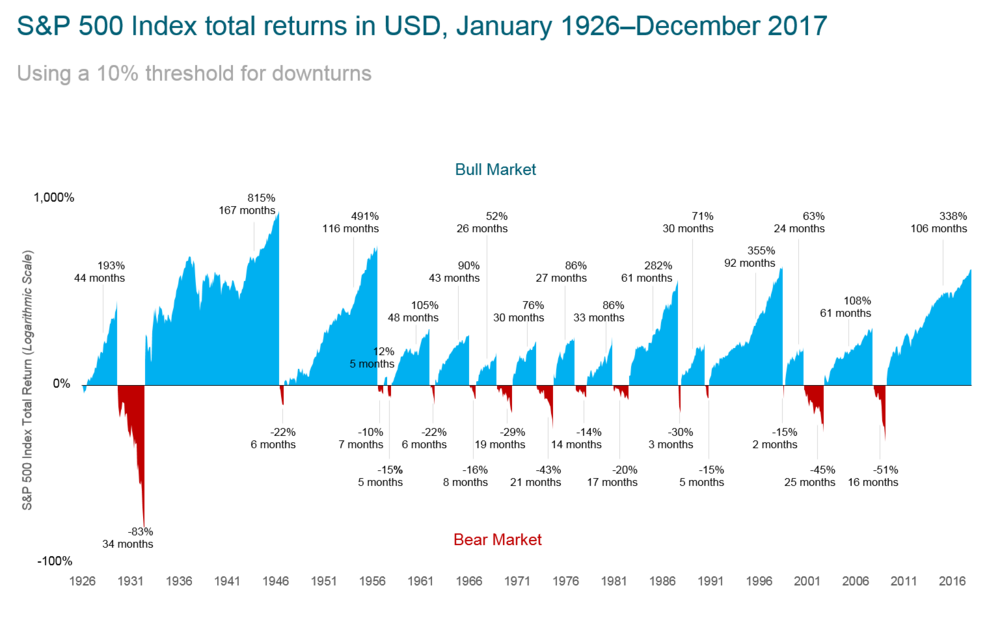
For those who are able to ride the market out, in theory, will benefit in the long run. The graph above shows us that in the last 90 years, the markets have grown more than they have fallen.

How does this affect the economy?
Because the businesses whose stocks are trading on the exchanges are participants in the greater economy, the stock market and the economy are strongly linked.

A bear market is associated with a weak economy as most businesses are unable to record huge profits because consumers are not spending nearly enough. This decline in profits, of course, directly affects the way the market values stocks.

In a bull market, the reverse occurs, as people have more money to spend and are willing to spend it, which, in turn, drives and strengthens the economy.

The Bottom Line
Both bear and bull markets will have a large influence on your investments, so it’s a good idea to take some time to determine what the market is doing when making an investment decision. Having the input from your financial adviser is crucial at this point – but neither market situation is better or worse than the other as both have opportunities and threats to your investment potential.

Remember that over the long term, the stock market has always posted a positive return.

Click here for the article on Investopedia

Why have the markets taken a knock?

In a nutshell, the markets are driven by business activity which is supported by investor confidence. When businesses have investors, they can grow and create more value, which in turn encourages more investors. When businesses can’t run normally (like in the case of a global pandemic), investors fear they will lose money and pull out their investments or stop supplying more cash – which hits the businesses even harder.

The interconnected world we live in means we are all affected by movements in other countries. Trade shutdowns and lockdowns on the other side of the world will affect everyone here too.

Whether it’s directly linked to investments, supply of goods to trade, or indirectly through the price of petrol for our cars or the supply and cost of goods in the grocery stores. Some of us will be fortunate not to lose our jobs, but our economy will shoulder the burden of those who do.

Events that knock global markets are often referred to as Black Swan events.

The Black Swan theory describes an event that is unpredictable and which has a significant impact. For example, if we take the effects of COVID-19 (Coronavirus) and add it to an oil war, spice it up with local business confidence being low we have a significant knock to our economy.

The good news is that we’re all in this together. We’re not isolated, which means that we can work together with greater strength and resolve to solve the problems that will stem from a global Black Swan event. We see this in how banks and other large companies step in to assist consumers.

“Recently, the coronavirus pandemic has added uncertainty to global markets. No one can confidently state its impact or for how long it will last. It has already impacted our tourism sector, slowed down economic activity and caused growth forecasts to be slashed. This has led to a large sell-off of riskier emerging market assets reflected in the over 25% drop in the JSE Top 40 index within the last month. The latest global travel bans and the drop in the S&P 500 by over 20% are indicators of the virus’s effect on first-world countries.” 22Seven

When we see words like “economic crash” filling up our Twitter feed, we may rightly begin to worry about our investments.

We have two options: sell now and time our re-entry or wait it out.

The market does recover – this has been proven time and time again over the last 90 years. As it stands, recovery times are, on average, just under two years when in a bear market (watch out for a blog coming soon on bull vs bear markets!).

However, it’s difficult to predict share price movements. This is another reason to not sell investments, as it’s difficult to predict when to buy them back. A good strategy for most would be to continue with monthly capital injections.

(Ideas for this blog come from 22seven)

Don’t sabotage your future self

Bad market performance, government lockdowns, global epidemics and loadshedding aren’t what threaten our investing and financial behaviour.

Our biggest threat is ourselves.

Studies have shown that people improve substantially in financial and investment decisions as they get older. When we are young — and perhaps less secure in our financial situation — we have a tendency to be controlled by emotional biases; strong impulses that can be detrimental to our investment habits.

Behavioural economists refer to some typical flaws that are commonly seen in investment decisions as failures of rationality. In order to achieve long-term financial goals, it is, therefore, important to identify and wrestle with some of our personality-driven investing mistakes.

Even more so when we’re going through a crisis and it’s confrontational!

It’s hard, but it’s not impossible.

The first step is to accept that a problem exists in the way that we approach our decision making – before we sabotage ourselves. It is then a question of devising a set of strategies to control, or at least mitigate, harmful decisions.

It’s important to be kind to yourself at this point – sabotaging your future self DOES NOT mean overextending yourself now to keep up with premiums, but it also means not selling off investments out of fear if it’s not in your best interest. The goal is to slow your decision process down so you avoid making errors you will regret.

According to a survey conducted by Barclays Wealth, many wealthy investors realise their tendency to make emotional decisions, and would be happy to have some help dealing with certain issues.

The ability to exercise control plays a vital part in financial decision-making, especially when investment climates can be volatile, confusing, and nerve-wracking. It is important to feel confident in your financial plan, so that you can resolutely commit to whatever investment strategy you decide will benefit your future self best.

For example, research suggests that there is a psychological phenomenon referred to as the trading paradox. A high percentage of investors feel they need to trade frequently in order to maximise their investment gains but, at the same time, many of the same investors feel that their overall returns suffer because they trade too much. Even though certain investors have this realisation and see the downfalls of their actions, they still give in to emotionally-triggered temptations and often miss out on optimal returns as a result.

Behavioural coaching, in this instance, could help someone to focus on methods of changing this behaviour for good.

Behavioural Coaching

Behavioural coaching employs a range of professional techniques to help you to make changes to certain patterns of behaviour. Behaviour comprises actions and reactions, and behavioural coaching has been defined by the Behavioural Coaching Institute as “the art of facilitating the learning and development of an individual, so as to increase their effectiveness and happiness”.

It emphasises that much of human behaviour is, in fact, learned, and that all behaviours result in positive or negative consequences for the individual and those around them.

This model of coaching, therefore, involves identifying and measuring certain learned behaviours and their impacts. To do this requires an exploration of core values and motivations, as well as assessing covert behaviours (such as anxiety or self-defeating beliefs) in relation to overt actions (such as public speaking).

Once you have identified an issue and sought professional guidance in establishing a personal set of effective coping mechanisms, it is important to consistently exercise your newfound good habits. These need to be practiced on an ongoing basis, and regular monitoring and evaluation will help you to achieve long-term success.

Fight the fear

When life doesn’t go according to plan, our first response will often be one of fear. Unfortunately, life generally never goes according to plan – so we encounter fear a lot!

Since fear cannot be avoided, we need to develop tools to cope with it so that we can allow it a constructive space in our lives, and not let it be a destructive force if left unchecked.

Hopefully, this brief article can spark conversations that will help us all learn to fight the fear in our daily lives and begin to explore our own unique reactions a little closer.

This blog is how we recognise our stress responses to fear, accept them and move past them.

If you ask most people what the typical responses to fear are, they may reply with ‘Fight or Flight’. But what many of us don’t know is that there are two more responses, these are Freeze and Fawn. None of these are good or bad, they’re just typical responses that we lean towards to cope with our fear.

With the help of trauma-informed treatment specialist, Patrick Walden, (LICSW), here are some brief overviews that he shared in an interview with The Mighty.

Fight (anger)
Those of us who tend toward the fight response innately believe power will guarantee the security and control that we may have lacked in childhood.

“Fight looks like self-preservation at all costs,” Walden told The Mighty, adding that this trauma response can manifest in explosive outbursts of temper, aggressive behavior, demanding perfection from others or being “unfair” in interpersonal confrontations.

He also noted that while we typically associate the fight response with men, women can also struggle with anger, though in many cases they direct their anger inward at themselves instead of toward others.

Recognising our default response to be angry will help us temper this response and create space to calm down before making any decisions or hurting people around us unnecessarily.

Flight (anxiety)
This fear response usually shows up in people who are chronically busy and perfectionistic. They may believe “being perfect” is a surefire way to receive love and prevent abandonment by important people in their lives.

“Flight can look like obsessive thinking or compulsive behavior, feelings of panic or anxiety, rushing around, being a workaholic or over-worrying, [and being] unable to sit still or feel relaxed,” Walden said.

Taking time to meditate and reduce anxiety is helpful for those of us who tend towards this type of response.

Freeze (avoidance)
Some of us who experience the freeze response are often mistrustful of others and generally find comfort in solitude. The freeze response may also refer to feeling physically or mentally “frozen” as a result of trauma, which people may experience as dissociation.

“Freeze looks like spacing out or feeling unreal, isolating [yourself] from the outside world, being a couch potato … [and having] difficulty making and acting on decisions,” Walden said.

If you feel like this when fear hits, having a few people you trust and can encourage you to take action would be helpful to overcoming your fears.

Fawn (accommodating)
Fawning is perhaps best understood as “people-pleasing.” According to Walker, who coined the term “fawn” as it relates to trauma, people with the fawn response are so accommodating of others’ needs that they often find themselves in codependent relationships.

“Fawn types seek safety by merging with the wishes, needs and demands of others. They act as if they unconsciously believe that the price of admission to any relationship is the forfeiture of all their needs, rights, preferences and boundaries.”

If you’re a ‘YES’ person and struggle to enforce boundaries, remind yourself that it’s okay to say ‘NO’ and put yourself first. If you don’t work on yourself you will have nothing to give others in times of crisis.

Remember, we will all experience fear – every day in fact. Most of the time the fear that we experience is easy to cope with, but when fear becomes debilitating we need to bring it in check so that we can move forward and not find ourselves stuck in our fear or reacting in fear.

For the full article on The Mighty – click here.

Understand what you need in your adviser

Here’s the thing about a 20-minute DIY job: it never takes 20 minutes.

Either you don’t have the right tools, or the right skills… or the materials turn out to be too hard, too soft, too big, too small etc.

On the rare occasion, it might take you 20 minutes or less. You might be perfectly suited to it, and have all you need on hand. For most of us – it doesn’t turn out that way.

The same is true for our financial planning. It’s not about relinquishing control, it’s about maintaining a fresh perspective on how you manage your money and making sure it’s being done in the best possible way.

A mentor once said that it’s easy to build a bridge – just pour an excessive amount of cement into the valley where you want to cross. When we think about this ridiculous idea, we realize how important engineers are.

Again – the same applies to accepting the need for a financial adviser, planner or coach. You can spend your money on whatever you want, but is that going to work out well for you? You can choose any risk or investment products you want online, but will those work out well for you?

If your money was cement, and you had to build a bridge to your future self, wouldn’t you want to have plenty of cement to make it across safely without running out of supplies in the first four meters?

A financial adviser will help, but you need to know what kind of adviser will suit you best.

Independent vs tied financial advisors
An independent financial advisor is someone who offers advice on products from multiple service providers. They usually work for themselves or are part of a group of independent financial advisors.

On the other hand, tied financial advisors will only provide advice on products their company offers. They typically have a deeper knowledge of a narrower set of products. There may be convenience or rewards related benefits when dealing with a single provider.

It’s important to identify which type of financial advisor you’re dealing with before signing any contracts with them.

Commission-based vs fee-based rates
Commission-based advisors are paid a commission on the products they sell. They are paid when the investment is made or the insurance policy is taken out and their advice is tightly coupled to the products they sell. However, they don’t charge a fee for meeting you.

Fee-based advisors charge a fee for advising you regardless of whether you purchase a product. There are advisors who operate a hybrid of these two structures and will benefit from both giving advice and selling products.

Fees will have an impact on the value of the investments you make and the insurance premiums you pay. Although they may sound burdensome, they are usually negotiable, so it’s worthwhile having a conversation about.

Don’t wait until you have lots of cement… uh, money.
You don’t need to be wealthy to have a financial advisor – this is a common misconception. You do however need a solid stream of income and a positive commitment towards making your money grow over time.

(Definitions from 22seven)

TO INVEST OR DISINVEST…THAT SEEMS TO BE THE QUESTION

Fund managers often tell us how they try and personalise their funds as this helps them when making certain decisions. They would often think of their grandparents or parents or close family friend and consider how decisions will impact them if they are the holder of the fund. So, when writing this article, we were faced with the same questions: ‘How are our parents, grandparents or siblings dealing with this sudden market crash?’ And, most important: ‘How are our clients perceiving the economic climate?’

The starting point is to provide some perspective as to what exactly happened. It is by pure chance that the coronavirus and the oil price crash overlapped and as these events coincided, it inflated the economic crisis. Furthermore, investors started to panic, and not only did we see a bulk buying of durable goods at our supermarkets, but also a panic sell-off in the stock markets.

Yes, it makes sense for a company like Sasol, which still earns a fair chunk of their income from oil, to crash when the oil price falls. Sasol has been busy with expensive projects in the USA and have incurred large amounts of debt over the last few years. Their oil business requires the oil price to trade at $35 a barrel or more in order to operate and repay debt.

There are typically two things that drive markets: fundamentals and sentiment.

With the frenzy of a global pandemic; factories closing; panic buying; fear of the unknown; small businesses forced to close temporarily, and travel bans, sentiment started to drive and fuel the sell-off we saw in the markets over the last few weeks. Adding to this, large economies started to see their central banks cut interest rates in order to assist with some money being pumped into the system. Normally this can spark a rally in the stock market, but markets initially didn’t respond positively to this news and interpreted these extreme measures from central banks as an indication that things are worse than expected. This pushed the markets down even further.

So, knowing some of the reasons behind what has been driving market negativity, investors are now faced with a very difficult decision: Do I disinvest or stay put?

The answer to this question isn’t as simple as you’d hope. You see, each investor is invested for a different life goal and for a different investment period and it will thus depend on many variables. It therefore isn’t a simple yes or no.

In a perfect world it would be great to know the following before we make a decision:

  1. Could markets go further down?
  2. When will markets recover?
  3. Is now a good time to cut my losses?

There are so many variables in the market that it is impossible to answer any of these questions without some sort of caveat or fine print.

If you were planning to retire:

Well, maybe give this a second thought. Unless you’ve reached retirement age and are forced to do so, you could reconsider and postpone your retirement. Many pension funds had exposure to the likes of Sasol and other shares, and your retirement capital could be less. Given that the bottom of this market crash is uncertain, postponing retirement could provide an opportunity for pension funds to recover, increasing the capital available with which to buy a pension income.

You’ve recently retired:

As wealth planners we have seen previous market corrections and more harsh market crashes. This is also why we draft investment plans for our clients first and trust they will stay the course and stick to the plan. As wealth planners we also believe in diversifying clients’ portfolios. As an investor you can opt to invest in many asset classes such as money markets, credit instruments, equities, property and bonds. When we look at the returns of these asset classes since 1 January to 17 March 2020, it shows that not all asset classes have reacted similarly and when blending different asset classes, you could potentially reduce the severity of a market crash on your portfolio.

What we have often seen is that once the panic dissipates, markets tend to recover quickly and investors who switched to safe-haven assets incur permanent losses on their portfolios that are seldom recovered. They would have been better off had they stayed in the market regardless of their anxiety.

You are fully invested:

If you were fully invested in equities, then switching to cash, as mentioned above, could mean permanently eroding the capital. Again, if you had a crystal ball and could say with absolute surety that the markets would go to 0, then I would agree that you cut your losses and try to save the bit you have left. However, if you have no surety as to where the bottom of this crash is, you also have no means of timing the recovery. Evidence shows that making no changes are often more effective than reacting on the sentiment and market noise. Answering questions such as: ‘Should I cut my losses?’, ‘Can it get worse?’ and ‘When will things get better?’, lead to emotionally driven decisions. It is often useful to learn from history and we do not have to look too far in the past to get such an example. In the 2008 great financial crisis, if you invested R100 in the JSE on 1 January 2007 and disinvested your money 31 December 2008, you would have cashed out R91.50. If you then decided to reinvest this back into the market on, let’s say, on 1 June 2009, your value as at 31 December 2019 would have been R311.80. However, if you didn’t disinvest and stayed put right through until 31 December 2019, your end value would have been R336.60. There might have been perfect market timers whose results would differ, but the calculation illustrates that missing the best days in the market or timing it just slightly wrong could have a worse outcome than staying invested.

You have money to invest:

You are very fortunate to be in this position. The world, as incredibly chaotic as it may seem, is offering you so much potential in terms of investments opportunities. For the first time we are seeing the shares of large companies offering good value. Although novice investors should take note that not all things that are cheap have value, there are good quality companies that present buying opportunities that haven’t been seen in a long time.

Bonds could also unlock great value, as the current valuations are attractive. When bond yields are high, their prices are low. This means that if you buy bonds at the current levels, you are buying a good interest income for years to come. It also presents the opportunity that a capital gain can be earned, as it is expected in times like these that interest rates will be reduced. As interest rates come down, bond prices tend to increase, leading to capital appreciation. Yields have recently picked up to levels last seen in 2008, and this could be a great opportunity for investors.

It is thus important to evaluate your own situation as an investor. Try to avoid following the herd. Consider what news really impacts you. When you see the headlines reading ‘JSE lost 22% since the start of the year’, it doesn’t mean every equity fund lost this amount and it doesn’t necessarily mean your wealth is down with 22%. Fund managers also diversify, and they make use of very complex instruments such as hedges to protect against such losses. As an example, whilst the JSE retracted by 22% over the last few months, some general equity funds lost only 7%.

Consider the silver lining as well. As interest rates are being cut, debt repayment becomes more affordable, and while Sasol (and most of the analysts and wealth planners out there) could not have foreseen the sudden price war of oil, this too brings some relief as petrol prices will come down in April. This could assist in reducing inflation in months to come.

The key takeaway from this article is to always analyse your own situation before reacting on the market noise and market news.

  1. Consider your time horizon. If you are a longer-term investor then avoid being short sighted during this time.
  2. Don’t get wrapped up in the bad news. Distinguish between noise and news.
  3. Make sure you understand the numbers.
  4. Stay the course if you have an investment plan. Your investment plan is tailored to your needs, wants, goals and time horizon.
  5. Don’t try and time the market. If you are planning to invest for a goal or a certain investment horizon, now is as good a time as ever. Time in the market is more important than timing the market.
  6. Diversify your portfolio.
  7. Don’t be fooled now in these panic times by schemes promising to deliver double digit guarantees. Remember that during these times we meet the bitcoins, Sharemax and fixed deposit businesses that disappear as quickly as they appear (with your hard-earned money).

As a final thought, it is best to consider that we live in different times and not all pandemics end the same way. Not all pandemics are equal, and some last longer or are more devastating. We should also note not all economic crises are the same and that even the recovery of the markets might take longer or shorter, and it might come just as quick as the sudden shocks.

What you could potentially do as an investor (private, professional or institutional), is consider your way of doing: Perhaps work longer, consider alternative means of generating income, review your budget, and finally, while the world is facing a global lockdown, be safe and considerate of your neighbour.

Keep a social distance and remain calm.

Financial wellness mindsets for life’s autumn

Autumn is a precious time of year and is perhaps an altogether more positive metaphor for another special time: the tail end of middle age when we are far from elderly, but far from young.

You look up one day and realise that while you were busy building a life with your family, or perhaps pursuing a fulfilling career, the years rolled by more quickly than you thought. There’s still time on the proverbial clock, but you’ve now reached the autumn of life. What can you do to ensure financial stability?

Just like autumn, this age is a time of rich maturity and transformation, pausing to enjoy the comforts of life you’ve stacked up for yourself and settling in for the winter.

The ‘autumn of life’ also, however, requires a completely different financial strategy and mindset. Here, some top tips for navigating your own ‘autumn’:

Hold to a relatively firm budget

By the time you’re in your mid to late fifties, the kids have most likely flown the nest to build futures of their own and if you’re fortunate, you may have already paid off your bond. This newfound financial freedom might tempt you to spend more extravagantly but now more than ever, a level head will be your best asset.

When you’re out with friends, entertain modestly and resist the urge to pick up everyone’s tab for the sake of appearances. At this point, you shouldn’t feel the need to impress those in your social circle.

Another important thing to bear in mind is that while you’re still an active member of the workforce, you should increase contributions to your retirement fund as much as possible.

Be an adviser to your children, but not an endless safety net

If you have kids, your natural inclination will always be to help them in troubled times, no matter how old they get. While admirable, your parental instincts must be balanced with a pragmatic approach to the shifting realities of your own life.

The fact is that very few older parents are in a position to act as an eternal wellspring of material resources and even if you are, the better course of action is to raise children with the strength and independence to stand on their own feet.

Never be afraid to learn something new

If there’s one tip that older professionals should consider taking from their 20-something counterparts, it’s the value of being willing to adapt to change and acquire new knowledge. With the plethora of reliable educational resources available online (often at low or zero cost), self-driven learning has never been easier.

Retirement expectations are changing fast too. With a combination of well-earned experience and some freshly developed skills, you might even be able to bolster that retirement fund with an entrepreneurial endeavour that only begins in your sixties.

Make your life easier – Part 3

Don’t avoid digital help. Whilst there are many dystopian stories about how robots will take over the world, those projected realities are highly unlikely to ever manifest.

AI, big data and cloud storage can be our friend in making our life easier – which is what technology was always intended for!

Granted, we can easily become disconnected from the material and relational world around us if we immerse ourselves too completely in the digital world, so balance is always crucial – but still, we can be astute in how we use it.

These tips are all about how digital space can create more space in your life

USE CLOUD STORAGE

Everyone seems to talk about ‘the cloud’ as if we all actually understand what that means. If you’re feeling left out, here’s a quick explanation. Storing information in the cloud means that you’re using someone else’s computer (called a hosting or cloud server, like Google Drive) to store your information, and that computer is always online. This means that you can access your information through the internet, from any device, in any location at any time – provided you have internet access.

Google, Microsoft, Dropbox – these are all good examples of cloud servers but there are literally hundreds of options.

The ultimate advantage to you is that your information is kept off-site. So… when you spill coffee on your laptop, a power-surge blows your desktop or you drop your phone in the loo, you don’t lose your data. You can store photos and family videos in the cloud. You might want to scan and save important documents – the options are limitless.

It also helps if you run a business. Instead of having an expensive local server, you can share all information in the cloud so that your team can access what they need. And again – should anything happen to a device (or everything in your office), you can keep valuable business information safe and accessible.

USE A VIRTUAL DIGITAL ASSISTANT (VDA, VA or DA)

Most smartphones come with a built-in DA (Siri and Alexa are great examples), but we use them to do fun things like finding out the time in a different country and playing a specific song.

But, you can use your DA to set up tasks and reminders. This can range from phone calls that you need to make, emails you might need to follow up on in two to three months or everyday tasks like managing your shopping list.

If you couple this tip with cloud storage, you can create shared lists that anyone in your family or team can update. From shopping lists, monthly budgets and wish lists for holidays, birthdays and home improvements, integrating your use of Siri in your daily life will make your life WAY easier.

If there is something in your life that is causing stress because it’s clumsy or cumbersome, see how you can change it to make your life easier!